Everybody Always

I recently finished reading Bob Goff’s book, Everybody Always: Becoming Love in a World Full of Setbacks and Difficult People.  What a great book!  The book is composed of stories with lessons about what it looks like to love other like Jesus does.

I have been reminded recently how I want to be focused on walking closely with Jesus and trying to be Jesus to everyone I come in contact with.  I do not have to live in fear with a “bunker” us vs. them mentality or make sure I have a checklist handy to make sure others believe exactly as I do.  My job as a disciple of Jesus is to allow Jesus to make me more like Him and also to love others with His great love.  I can verbally share with others about Jesus, but only God can do the transforming work needed in people’s hearts.  I want to be patient, kind, graceful with others.  The love of Jesus is not careful and without risk.  It is extravagant and sometimes even dangerous.  God has used other people in my life to show me His love, which has changed me.  I can hardly believe that God wants to use me (in spite of my own imperfections) to be His ambassador of life-changing love to others.  I do not want to be found waiting in the bleachers, but I want to get busy with this adventure.

Here are some quotes from this book which I was impacted by:

  • “He wants our hearts, not our help.” (p. 72)
  • “It’s not about us anymore; it’s about Him. (p. 73)
  • “People who are turning into love don’t need all the spin, because they aren’t looking for applause or validation from others any longer.  They’ve experienced giving away God’s love as its own reward.  They also don’t need to write ‘Jesus’ as the return address of every loving thing they’ve done.” (p. 73)
  • “People who are becoming love talk a lot more about what God’s doing than what they’re doing because they’ve stopped keeping score.” (p. 74)
  • “We don’t need to send the archers to the tower to protect baby Jesus every time someone hits a wrong note.  Read the book of Revelation.  He’s out of the crib.  Should we have a firm grip on doctrine and know what the Bible speaks to the world?  You bet.  Keep this in mind, though: loving people the way Jesus did is always great theology.” (p. 83)
  • “Playing it safe doesn’t move us forward or help us grow; it just finds us where we are and leaves us in the same condition it found us in.  God wants something different for us.  His goal is never that we’ll come back the same.  He’s hoping we’ll return more dependent on Him.  I’m not saying everything needs to be risky in our lives, but we’d be well served if a few more things were riskier in our faith.  Loving people we don’t understand or agree with is just the kind of beautiful, counterintuitive, risky stuff people who are becoming love do.” (p. 87)
  • “We don’t decide who in line is in and who’s out, and we don’t need to waste any more time engaging in the kinds of arguments some people get sucked into.” (p. 113)
  • “I’ve met a lot of people who say they’re waiting for God to give them a “plan” for their lives.  They talk about this “plan” like it’s a treasure map God has folded up in His back pocket.  Only pirates have those.  People who want a reason to delay often wait for plans.  People who are becoming love don’t.” (p. 145)
  • “But here’s what’s changing in me: I don’t want what’s fair anymore.  I want to be like Jesus.  It’s a distinction worth making.” (p.150)
  • “It’s taken some time, but I’m starting to act like my purpose is to love God and to love the people around me the way Jesus loved the people around Him.  As much as I’d like to make it more complicated and have more steps so I can find some cover for my inaction, it’s really that simple.” (p. 165)
  • “Loving people the way Jesus did means being constantly misunderstood.  People who are  becoming love don’t care.  They will do whatever it takes to reach whoever is hurting.” (p. 216)
  • “Don’t just love the people who are easy to love; go love the difficult ones.  If you do this, Jesus said you’d move forward on your journey toward being more like Him.  Equally important, as you practice loving everybody, always, what will happen along the way is you’ll no longer be who you used to be.  God will turn you into love.” (p.219)



Vocab

I love it when I am reading a book and there are lots of words that I do not know. As I am reading, I look up the definitions of those words. It’s an indication to me that I am reading a book by a smart author who I can learn from. I’m currently reading The Corrosion of Conservatism: Why I Left the Right by Max Boot. It’s a very good book, but very disturbing in terms of our current political situation in the U.S.  There is much to comment on in terms of the content of this book, but instead now I’m going to share the words I looked up this weekend as I was reading it.  A good number of the words I have seen before, but if I am not confident of what the word means I look it up.  Here they are:

Vocabulary Ninja

disquisition – (noun) a long or elaborate essay or discussion on a particular subject

acerbic – (adjective) (especially of a comment or style of speaking) sharp and forthright

fete – (verb) honor or entertain (someone) lavishly

vituperate – (verb) blame or insult (someone) in strong or violent language

tyro – (noun) a beginner or novice

aspersion – (noun) an attack on the reputation or integrity of someone or something

calumny – (noun) the making of false and defamatory statements in order to damage someone’s reputation; slander

chortle – (verb) laugh in a breathy, gleeful way; chuckle

apoplectic – (adjective) overcome with anger; extremely indignant

tocsin – (noun) an alarm bell or signal

histrionic – (adjective) overly theatrical or melodramatic in character or style

cant – (noun) hypocritical and sanctimonious talk, typically of a moral, religious, or political nature

screed – (noun) a long speech or piece of writing, typically one regarded as tedious

cognoscenti – (noun) people who are considered to be especially well informed about a particular subject

bunkum – (noun) nonsense

frisson – (noun) a sudden strong feeling of excitement or fear; a thrill

insouciance – (noun) casual lack of concern; indifference

oleaginous – (adjective) exaggeratedly and distastefully complimentary; obsequious

trope – (noun) a figurative or metaphorical use of a word or expression

conflate – (verb) combine (two or more texts, ideas, etc.) into one

supine – (adjective) failing to act or protest as a result of moral weakness or indolence

autarky – (noun) economic independence or self-sufficiency


By the way, studies have shown that people with bigger vocabularies are more successful in life.  Here’s a link to a short article that explains this:  Vocabulary.

Pride and Humility

As I mentioned before, I text quotes to my boys and wife each day.  Here are the quotes of the day from the last two days.  Today’s quotes were about pride and yesterday’s were about humility.

“There are two kinds of pride, both good and bad.  Good pride represents our dignity and self respect.  Bad pride is the deadly sin of superiority that reeks of conceit and arrogance.”           by John C. Maxwell

“Being a father has been, without a doubt, my greatest source of achievement, pride and inspiration.  Fatherhood has taught me about unconditional love, reinforced the importance of giving back and taught me how to be a better person.”     by Naveem Jain

Yesterday’s quotes:

“Humility is the foundation of all the virtues hence, in the soul in which this virtue does not exist there cannot be any other virtue except in mere appearance.”   by Saint Augustine

“Humility is the gateway into the grace and favor of God.”   by Harold Warner

Snobbery

Snobbery

As I mentioned in my blog post from yesterday, my favorite Joseph Epstein book is Snobbery: The American Version.

Just for fun, here is a sampling of some of my favorite quotes from that book:

“But snobbery, like bacteria, is found everywhere.” (Preface)

“Behind all acts of snobbery is, somehow or other, a false or irrelevant valuation.” (p.10)

“In the United States, contempt for social inferiors more than anything else marked the snob.” (p.14)

“By way of preliminary definition: a snob is someone who practices, lives by, exults in the system of distinctions, discriminations, and social distractions that make up the field play for snobbery.”  (p.15)

“The essence of snobbery, I should say, is arranging to make yourself feel superior at the expense of other people.” (p. 15)

“Snobbery often entails taking a petty, superficial, or irrelevant distinction and, so to say, running with it.” (p. 15)

“There is something deeply antisocial about the snob.  He is, in a profound sense, in business for himself.” (p. 17)

“I take the snob as someone out to impress his betters or out to depress those he takes to be his inferiors, and sometimes both; someone with an exaggerated respect for social position, wealth, and all the accouterments of status; someone who accepts what he reckons to be the world’s valuation on people and things, and acts – sometimes cruelly, sometimes ridiculously – on that reckoning; someone, finally, whose pride and accomplishment never come from within but always await the approving judgment of others.  People not content with their place in the world, not reconciled with themselves, are especially susceptible to snobbery.” (pp. 18-19)

“Snobbery, like religion, works through hope and fear.  The snob hopes to position himself securely among those whom he takes to be the best, most elegant, virtuous, fashionable, or exciting people.  He also fears contamination from those he deems beneath him.” (p. 20)

“To be one up, someone else must be pushed one down, and so there has always been the element of one-upmanship about snobbery.” (p. 24)

“Yet the real snobbery question is whether one is taking pleasure in a thing or activity for itself or because the pleasure is that other people – most people, in fact – are for one reason or another excluded from it.” (p. 24)

“Delight in excellence is easily confused with snobbery by the ignorant.” (p. 27)

“The pressing question for the snob, as for the snobographer, is to find out who just now is on top and how social gradations are worked out from there down.  Inquiring snobs want – make that need – to know.” (p. 62)

“…dispute can be endless about what constitutes correct taste, and in the hands of a snob taste can be wielded as a cruelly effective weapon, used to keep all sorts of people outside the gates.” (p.76)

“The snob’s error is to put good taste before a good heart – to put good taste before almost everything else.” (p.81)

‘A snob, in one common definition, is anyone who thinks himself superior in a way that demands recognition.” (p. 91)

“The snob requires prestige, cannot get along without it, thinks possession of it will eliminate his greatest of all fears – that of being nobody.” (p.95)

“What he (the snob) fails to comprehend is that neither can be obtained, at least not successfully, as an end in itself.  Prestige accompanies high achievement, is an accouterment of solid accomplishment.  At the banquet of life, status is a side dish, never a main course.  Prestige and status come by the way; they are not, in themselves, the way.” (p.99)

“Clubs are as much about keeping people out as joining them together, which is why they have always had a central place in the history of snobbery.” (p. 133)

“Even with the best intentions and histories of good works behind them, clubs are snobbery organized.” (p.134)

“…to present oneself as a victim allows one to cut the ground out from others who make an appeal on the basis of their own victimhood.”  “…if one carefully sets oneself up as a victim, one is in a position of moral superiority to anyone who cannot make the same claim.” (p. 155)

“But politics nowadays tends to be less about reason than ever; it is much more about making us feel good at the expense of those who aren’t as kind, generous and sensitive as we.” (p.161)

“The snob’s problem is that he allows himself to make judgments based on fashion, to let the competitive edge that lurks about fashion gain sway, to find being out of fashion veritable hell.  For the snob, fashion becomes a standard of judgment, a means of gratification, a method of acquiring self-esteem, an ethics, something akin to a religion, and of course a stick with which to beat on those who fall behind or get it wrong.” (pp. 176-177)

“Name-dropping is also a form of social climbing – social climbing on the cheap.  It’s social climbing because it suggests to people on whom one uses it that you are in a higher, more exciting world than you probably really are.” (p. 192)

“It is one thing to be distinguished from the ordinary.  But people who worry a good deal about celebrity – about not having it, or about not having enough of it, or about losing it – are contending with essentially snobbish emotions.” (p.198)

“Every act of snobbery is at bottom an act of weakness.  Often it is weakness striking out, showing its cruel side.  Sometimes it shows this by condescension, sometimes by pretension, sometimes by unconscious vulgarity.” (p. 247)

And finally the conclusion,

“Snobbery will die on the day when none of us needs reassurance of his or her worth, when society is so well balanced as to eliminate every variety of injustice, when fairness rules, and kindness and generosity, courage and honor are all rightly revered.  But until that precise day arrives – please, don’t mark your calendars yet – snobbery appears here to stay.” (p.251)


Aleksandr and Joe

I just finished my fourth book by Jospeh Epstein, Essays in Biography.  For some strange reason, I like reading long books (this one was 564 pages).  The other books by Joe which I have read are: Snobbery: The American Version, Friendship: An Expose and Narcissus Leaves the Pool: Familiar Essays.  I love Joseph Epstein’s writing.  The first of the books above that I read by him was the one on snobbery.  It is one of my favorite books, and I recommend it to people all the time.  I have enjoyed these other books by him, but I have not found any of them to be as profound and funny as my favorite.  I currently have one more of Epstein’s books in my bookshelf: Literary Genius: 25 Classic Writers Who Define English and American Literature.

I like reading biographies about inspirational people, but many of the mini biographies in this book were not about admirable characters so they were not as fun for me to read.  Aleksandr Solzhenitsyn is an exception – he is an admirable character, and I enjoyed reading about his life.  When I was traveling on a semester in Europe program in college, I read his book, One Day in the Life of Ivan Denisovich.

Aleksandr was an underground writer in the Soviet Union for more than twenty years.  He was a novelist, historian and short story writer.  He was an outspoken critic of the Soviet Union and communism.  He helped to raise global awareness of the Soviet Gulag forced labor camp system.  As such, much of his reading is sad and difficult to read.  His works helped to debunk what remained of Western illusions about the great Communist experiment.  He was a prophet, a man on a mission who told people what he thought.  It would not be too much to say of him that he helped to destroy communism.  He was not blind, however, to the spiritual emptiness of the West and he said, “Excessive ease and prosperity have weakened their will and their reason.”

Epstein did not discuss Aleksandr’s faith much, but I am very interested in that and the role his faith played in his life.  If you would like to learn more about his faith, here is a link to a good article about that:  http://www.cslewisinstitute.org/webfm_send/558.


By the way, the quote of the day which I sent out to my family today is from Bob Cousy (point guard for the Boston Celtics from 1950 – 1963):

“Do your best when no one is looking.  If you can do that, then you can be successful in anything that you put your mind to.”

Victor

My oldest son is reading a Victor Frankl book for one of his college courses.  In honor of him, the two quotes of the day which I sent out to my family today were from Victor:

“Everything can be taken from a man but one thing: the last of the human freedoms – to choose one’s attitude in any given set of circumstances, to choose one’s own way.”

AND

“Those who have a ‘why’ to live, can bear with almost any ‘how’.”


In order to meet my goal of reading 40 books this year, I am going to need to step up my reading (I just finished #25 tonight).  One of my challenges is that I cannot stop myself from choose long non-fiction books!

Insurgence

I have been reading Frank Viola’s book, Insurgence, with two of my friends.  We’ve been discussing the book for a few weeks now.

Insurgence

Here are some quotes which represent some of the ideas discussed in the book:

“Properly conceived, the Christian life is one of beholding, enjoying, and reflecting the beauty of Christ.  It is essential that we become fascinated, gripped, and captivated by the Lord.  If not, we will struggle with boredom, and our hearts will be vulnerable to pursue other things.” (p.53)

“Put another way, the early Christians were seen as insurgents.  They switched all their allegiances to Jesus Christ.” (p.85)

“The messages of John (the Baptist), and later Jesus and Paul, was a call to join the insurgence.  One that contained no violence, no armed conflict, and no rebellious overthrow.  Rather, the insurgence that John announced was built on a subversive message that people believed, lived out, and heralded to others.  It constituted a nonviolent revolution, a quiet revolt against the present order.” (p.97)

“In sum, the kingdom of God includes the King (the ruler), God’s reign (rulership), and the people ruled (realm).  Again, the kingdom is the manifestation of God’s ruling presence.  And His ruling presence is manifested in and through Jesus and in and through God’s people.” (p.106)

“Whenever Jesus is enthroned by a group of people today, that’s where the kingdom of God is.  Wherever a group of people submit to the kingdom of Christ, the kingdom of God is in their midst and they experience righteousness, peace, and joy in the Holy Spirit.” (p.120)

“The kingdom of God is already but not yet.  In other words, the kingdom is here (already), but it hasn’t arrived in its fullness (yet).  The kingdom is present, yet it’s future.” (p.121)

“The gospel of the kingdom is scandalous.  And so it brings great opposition.” (p.137)

“…countless Christians embrace an ambition to do something great for God.  But if you peel back the layers of that onion, self is lurking behind it all.  Indeed, the pleasure of being used, recognized, and seen as valuable to God must be laid upon the altar and burnt to ashes.  The altar means the willingness to lose our reputations.” (p.188)

“Desperation is the currency of God’s kingdom.  The more desperate you are, the more ground you taken in the kingdom.” (p.194)

“In short, the best way to renew your love for Christ is to review His love for you.” (p.197)

“Therefore, we are deluded whenever we lessen the sins we’ve committed and magnify the sins of others…whatever they might be.  Let us, therefore, be harsh with ourselves in the matter of sin and compassionate to everyone else.” (p.225)

“…the clock is ticking on the world system.  One day it will pass away.  And that’s one of the greatest revelations you and I can have in terms of breaking loose from any attachment we have to it.  The world system is doomed.” (p.254)

“How we spend our time and money reveals where we stand with the kingdom of God more than anything else.  Those two things reveal whether or not we are part of heaven’s culture or the world’s.” (p.275)

“Whenever kingdom-minded people own a possession, they don’t view it as their own property.  Instead, they are keenly aware that everything they own belongs to the Lord as well as to their fellow sisters and brothers in Christ.” (p.281)


Finally, I have had fun continuing to send out a quote of the day to my family via text.  Here’s the quote from last Thursday by M. Scott Peck, “Problems do not go away.  They must be worked through or else they remain, forever a barrier to the growth and development of the spirit.”

I just started a subscription to two magazines which I would recommend, Christian History and Modern Reformation.

Quote of the Day

Since the beginning of this year, I’ve been trying to text a quote each day to my wife and 3 boys.  I was consistent for a couple months at the beginning of the year, but then I wasn’t.  This last week, I re-committed to be faithful with this because I like doing it and it is fun for me.  It also sometimes leads to good family conversations.

Today’s quote was from Ruben Mark, past Chairman and CEO of Colgate-Palmolive,

“Stand up for what’s right, in small matters and large ones, and always do what you promise.”

13063145-Casual-man-standing-Stock-Photo-full

Screwtape

Devil

I’m really enjoying reading The Screwtape Letters by C.S. Lewis to my 15 year old son.  Last night we read something I want to share.  In this satirical book, Screwtape is a senior demon giving advice to his nephew, Wormwood, about how to best tempt, distract and destroy the life of his human “patient” who has recently become a Christian.

“Never forget that when we are dealing with any pleasure in its healthy and satisfying form, we are, in a sense, on the Enemy’s ground.  I know we have won many a soul through pleasure.  All the same, it is His invention, not ours.  He made the pleasures:  all our research so far has not enabled us to produce one.  All we can do is to encourage the humans to take the pleasures which our Enemy (God) has produced, at times, or in ways, or in degrees, which He has forbidden.  Hence we always try to work away from the natural condition of any pleasure to that in which it is least natural, least redolent of its Maker, and least pleasurable.”

It was great to talk with my son about this truth that God made all the pleasures!

Trust

Trust

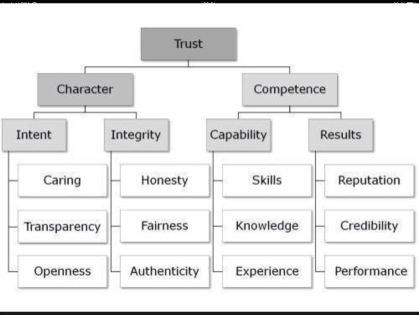
In Stephen Covey’s book, The Speed of Trusthe emphasizes that what you do is much more important than what you say.  He then elaborates 13 behaviors of high trust leaders.  Here they are:

  1. Talk Straight – Be honest. Tell the truth.  Let people know where you stand.  Use simple language.  Call things what they are.  Demonstrate integrity.  Don’t manipulate people or distort facts.  Don’t spin the truth.  Don’t leave false impressions.
  2. Demonstrate Respect – Genuinely care for others. Show you care.  Respect the dignity of every person and every role.  Treat everyone with respect, especially those who cannot do anything for you.  Show kindness in the little things.  Don’t fake caring.  Don’t attempt to be “efficient” with people.
  3. Create Transparency – Tell the truth in a way that people can verify. Get real and genuine.  Be open and authentic.  Err on the side of disclosure.  Operate on the premise of “What you see is what you get.” Don’t have hidden agendas.  Don’t hide information.
  4. Right Wrongs – Make things right when you are wrong. Apologize quickly.  Make restitution where possible.  Practice “service recoveries.”  Demonstrate personal humility.  Don’t cover things up.  Don’t let pride get in the way of doing the right thing.
  5. Show Loyalty – Give credit freely. Acknowledge the contributions of others.  Speak about people as if they were present.  Represent others who aren’t there to speak for themselves.  Don’t bad-mouth others behind their backs.  Don’t disclose others’ private information.
  6. Deliver Results – Establish a track record of results. Get the right things done.  Make things happen.  Accomplish what you’re hired to do.  Be on time and within budget.  Don’t overpromise and under deliver.  Don’t make excuses for not delivering.
  7. Get Better – Continuously improve. Increase your capabilities.  Be a constant learner.  Develop feedback systems – both formal and informal.  Act on the feedback you receive.  Thank people for feedback.  Don’t consider yourself above feedback.  Don’t assume today’s knowledge and skills will be sufficient for tomorrow’s challenges.
  8. Confront Reality – Take issues head on, even the “undiscussables.” Address the tough stuff directly.  Acknowledge the unsaid.  Lead out courageously in conversation.  Remove the “sword from their hands.” Don’t skirt the real issues.  Don’t bury your head in the sand.
  9. Clarify Expectations – Disclose and reveal expectations. Discuss them.  Validate them.  Renegotiate them if needed and possible.  Don’t violate expectations.  Don’t assume that expectations are clear or shared.
  10. Practice Accountability – Hold yourself accountable. Hold others accountable.  Take responsibility for results.  Be clear on how you’ll communicate how you’re doing – and how others are doing.  Don’t avoid or shirk responsibility.  Don’t blame others or point fingers when things go wrong.
  11. Listen First – Listen before you speak.   Diagnose.  Listen with your ears – and your eyes and heart.  Find out what the most important behaviors are to the people you’re working with.  Don’t assume you know what matters most to others.  Don’t presume you have all the answers – or all the questions.
  12. Keep Commitments – Say what you’re going to do, then do what you say you’re going to do. Make commitments and keep them.  Make keeping commitments the symbol of your honor.  Don’t break confidences.  Don’t attempt to “PR” your way out of a commitment you’ve broken.
  13. Extend Trust – Demonstrate a propensity to trust. Extend trust abundantly to those who are earning your trust.  Learn how to appropriately extend trust to others based on the situation, risk, credibility (character and competence) of the people involved.  But have a propensity to trust.  Don’t withhold trust because there is risk involved.