The picture of the two chairs is where I read to my oldest son this morning. That, along with the 30 minutes of rebounding I did for him, was my favorite activity of the morning.


I love it when my family members wake up each day, but I also really enjoy reading before any of them wake up. Yesterday, I woke up at 5:20 am and went off for a crazy running work out at the track of our local high school. This morning, however, I enjoyed a variety of reading. First of all, there was a delay in the delivery of the newspaper. My normal routine is to read my Bible first and then read the newspaper while I enjoy a cup of coffee. After that, I use my remaining time before family members rouse to read whatever other book(s) I feel like reading.
So…since the newspaper did not arrive in a timely fashion, here is what I read in chronological order:
- The Bible: I am working on a memorization project and these were the verses I was practicing this morning from the fourth chapter of Ephesians: “Therefore, having put away falsehood, let each of of you speak the truth to his neighbor, for we are members of one another. Be angry and do not sin; do not let the sun go down on your anger, and give no opportunity to the devil. Let the thief no longer steal, but rather let him labor, doing honest work with his own hands, so that he may have something to share with anyone in need. Let no corrupting talk come out of your mouths, but only such as is good for building up, as fits the occasion, that it may give grace to those who hear.”
- Narcissus Leaves the Pool by Joseph Epstein: he is a very fun writer to read. I finished his essay/chapter titled, “A Nice Little Knack for Name Dropping”. A couple quotes from this, “What name dropping is…is using the magic of celebrated people to establish one’s superiority while at the same time making the next person feel the drabness of his or her own life. Name dropping is a division of snobbery, and one of the snob’s missions is to encourage a feeling, however vague, of hopelessness in others”. And later in the chapter, “Behind much name dropping is a desire for distinction. Look, the name-dropper implies with each fresh drop, I am distinguished, at least by association.” “The desire to be taken for distinguished seems all but universal.” I must say that I am not immune from name-dropping, but I also do not like it at all. In recent years, I have made effort to resist the temptation to name drop. It has an ugliness and snobbishness to it. For a VERY fun read, please check out Mr. Epstien’s book, Snobbery. I’ve read it twice and will read it again sometime when I need to laugh. Anyway, I start the next chapter titled, “So to Speak”. It is about our pronunciation and mispronunciation of words, “Why does it feel so foolish, so ketchup on one’s white shirt-front, so absolutely fly open at the senior prom, to know one has been mispronouncing a word?” “A mispronounced word or name has to be considered a lapse in taste, but unlike normal poor taste, it is brought about by genuine ignorance. It also represents a self-puncturing of one’s own pretensions, assuming one has any, and I happen to have quite a few.”
- Pursuing God’s Will Together: A Discernment Practice for Leadership Groups by Ruth Haley Barton: I finished the chapter titled, “Values that Undergird Community”. One of the values discussed was conflict transformation. I am conflict averse so this hit home as I would rather avoid it! “One of the most important aspects of long-term community is agreeing to very concrete commitments regarding how we will handle the inevitable conflict.” “it is a commitment for us to seek transformation in and through conflict.” “Commitment to engaging conflict in a way that changes us for the better and deepens our unity in Christ is more challenging that conflict management or conflict resolution…”
- The Great Ideas: A Lexicon of Western Thought by Mortimer J. Adler: I have been reading this long book for a few years off and on. It is made up of 101 chapters, each one dedicated to an “idea” that Mr. Adler thought was one of the 101 great ideas of Western thought. The breadth and depth of his writing is amazing. This morning I read the chapter on “Eternity”. This stretched my mind so early in the morning! Here’s a sampling, “But even so it can still be asked how the truth exists, for the attribution of eternity to anything also requires us to consider its mode of being. If, for example, the truth exists only in the mind, then it exists unchangingly only in the mind of an absolutely infallible knower, a mind which neither learns nor forgets, nor changes in any respect with regard to what it knows. If God is such a knower, eternal truth can have existence in God’s mind.”
- The Dictionary of Christian Thought edited by Adrian Hastings, Alistair Mason and Hugh Pyper: this has also been a long term reading project for me. My friend, Phil Stone, gave this to me years ago and I’ve slowly been working through it. I’m still on the “D’s”, but I would like to read it more often as I always learn from what I read here. This morning I read entries on Emily Dickinson, Dionysius the Pseudo-Areopagite, discipleship and Dispensationalism. My next topic is divine command ethics.
- Mere Christianity by C.S. Lewis: This was my favorite reading of the morning because I read from this book to my oldest son (17) while he enjoyed the hot chocolate that I prepared for him. We are only three pages away from finishing this book. My wife will not understand how we could have stopped so short of the finish line!
I enjoy my reading more when I encounter words that I do not know. This morning there were two I needed to look up:
- Mellifluous: (of a voice or words) sweet or musical; pleasant to hear (I cannot ever remember encountering this word before)
- Sycophant: a person who praises powerful people in order to get their approval (this is one of those words which I have looked up numerous times and cannot seem to remember the definition)
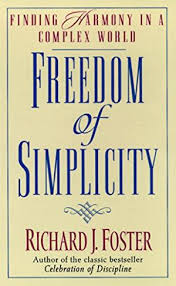 I love this quote from Richard Foster’s Freedom of Simplicity book. I’ve read it so many times to my family, I think my boys have it memorized. This quote also makes me feel good about my hatred of shopping for clothes for myself and feel okay about not having new and fashionable clothes.


 Forty Books